Ecommerce Chatbot Operations vs Outsourcing: Which Fits Your Team?
Quick Summary: The decision between in-house and outsourced chatbot operations hinges on who owns updates after launch, with in-house control winning for frequently changing products and outsourcing fitting teams lacking capacity or specialist skills. A hybrid model often works best, keeping policy decisions in-house while a specialist handles execution, and most Shopify teams should let AI handle routine chats while humans manage complex cases. The article emphasizes that stale content causes most chatbot errors, not weak AI, so a named owner must handle knowledge base updates, weekly QA reviews, and escalation tracking.
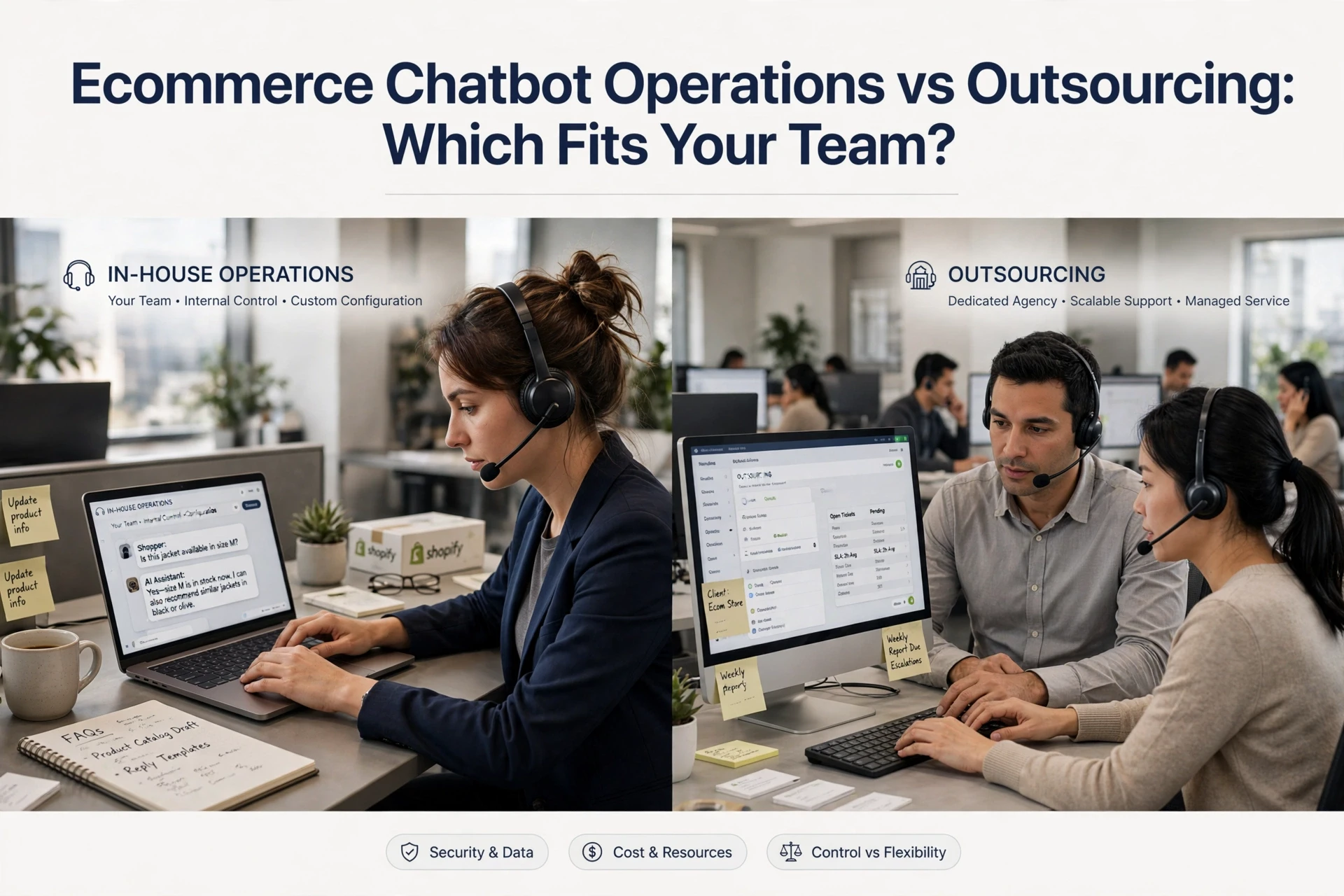
This ecommerce chatbot operations vs outsourcing decision comes down to one question: who owns updates? If your products and policies change often, in-house control wins. Outsourcing fits when nobody reliably owns setup, QA, and tuning. A hybrid often works best - your team keeps policy decisions, a specialist handles the rest. Below, we compare control, workload, quality oversight, and continuity, plus a quick ownership check. Written by Kandid, a Shopify AI chatbot platform.
In-House Chatbot Operations vs Outsourcing: At a Glance
| In-house chatbot operations | Outsourced chatbot operations | |
|---|---|---|
| Operational control | Direct control over rules, data, and priorities | Shared, defined by contract and permissions |
| Internal workload | Team owns setup, review, and updates | Lower execution burden; oversight remains |
| Quality ownership | Internal owner accountable for QA and escalation | Provider executes; merchant retains brand accountability |
| Change handling | Internal team can act on store changes directly | Depends on scope, response times, and change process |
| Best fit | A team with a named, available operator | A team lacking capacity or specialist implementation skills |
How In-house chatbot operations and Outsourced chatbot operations Compare
This ecommerce chatbot operations vs outsourcing decision starts with who runs the bot day to day. Here are the two contenders.
In-house chatbot operations
Your own team configures, monitors, and improves the chatbot using internal product, policy, and customer knowledge. It suits teams with a named, available operator who owns QA and escalations. You get direct control over rules, data, and store changes.
Key strengths
- Direct control over rules, data, and priorities
- Fast response to store and catalog changes
- Clear internal accountability for quality
Outsourced chatbot operations
An external specialist or agency handles agreed chatbot implementation tasks under merchant-approved scope and access. It fits teams lacking capacity or specialist skills. You keep oversight and brand accountability while the provider executes.
Key strengths
- Lower execution burden on your team
- Access to specialist implementation skills
- Contract-defined scope and permissions
Who Owns the Work After Launch?
Launch is not the finish line. Someone has to keep the chatbot accurate once real shoppers start asking questions. The most common mistake is handing maintenance to IT or treating it as nobody's job. Your CX or support team should own it, because they know what a good answer sounds like. Industry guidance suggests planning 3-5 hours per week for updates, quality checks, and monitoring.

The recurring tasks:
- Update the knowledge base when policies, prices, or products change.
- Review a weekly sample of conversations for wrong answers.
- Track resolution rate and escalation trends.
Stale content causes most chatbot errors, not weak AI. If you outsource, contract terms should name who handles each of these tasks.
Also Read: Ecommerce Chatbot Knowledge Base Maintenance: A Practical Operations Guide
Control, Capacity, and Quality Trade-Offs
Running your own chatbot keeps control but eats team hours. Outsourcing adds capacity but loosens your grip on tone and policy. Either way, the same question decides quality: who holds the keys, and how well they were handed over.
What to Check Before Handing Off Access
Give the least access needed, never shared admin passwords. Use role-based accounts so each person sees only what their job requires, a model contact-center access guides call least privilege. In Shopify, create staff accounts limited to orders, tracking, and your helpdesk. Block payouts, theme edits, and payment settings.
- Write down refund limits and escalation rules
- List what must never be edited or shared
- Log every access change for review
- Set a weekly QA sample of real replies
Also hand over a policy pack: return windows, shipping cutoffs, and brand voice examples. Practitioner handoff checklists stress documenting policies before go-live, since agents who guess create inconsistent answers.
Also Read: Ecommerce Chatbot Human Handoff vs Full Automation for Shopify
Which Operating Model Fits Your Team?
Most Shopify teams land in one of three camps: run the chatbot and tickets in-house, outsource coverage, or blend both. The right fit depends on volume, hours, and how complex your product questions get.
| Factor | In-House | Outsourced | Hybrid |
|---|---|---|---|
| Best volume | Low, steady | High, spiky | Growing |
| Coverage | Business hours | 24/7 | Extended |
| Cost pattern | Fixed salary | Per-seat, variable | Mixed |
| Brand control | Highest | Shared | High on key cases |
Research on customer satisfaction found insourced support scores better on the human side of service, but the operational side shows no real difference, so cost and coverage should drive the call, not fear of quality loss, per this insourcing study. Many teams now keep VIP and complex escalations in-house and route routine chat volume out, a shift covered in ecommerce support comparisons.

If most tickets are order status or returns, start in-house with a good AI chatbot. Outsource when queues outpace hiring.
If a hybrid setup makes sense, see how Kandid handles the routine chats so your team can focus on the rest.
Frequently Asked Questions
Q1: Should stores manage chatbot operations internally or outsource them?
Most small Shopify teams start with software plus in-house owners, since the AI handles routine questions. Outsource only when ticket volume outgrows your staff or you need CX expertise you lack. A hybrid model works best.
Q2: What tasks can I safely hand to a chatbot without hurting customer experience?
Order tracking, FAQs, product questions, and simple recommendations. Route refunds, complaints, and edge cases to a human quickly so trust stays intact.
Q3: How do I decide which tasks to outsource to an agency or freelancer?
Track chat volume weekly. Outsource work that repeats, follows clear rules, and needs speed. Keep judgment-heavy tasks like VIP issues in-house.
Q4: Can I mix in-house and outsourced chatbot operations?
Yes. Many teams let AI tools like Kandid handle first responses, keep founders on product answers, and outsource overflow tickets during peaks.
Next Steps for Your Chatbot Operating Model
Pick hybrid: let AI handle routine chats, keep humans for complex cases. Research backs this blended model as the best fit for most Shopify teams.