Chatbot-Influenced Sales vs Incremental Lift on Shopify Explained
Quick Summary: Chatbot-influenced sales only show correlation, not causation, so they can mislead Shopify merchants into overcrediting their bot. To measure true chatbot incremental conversion lift, run a holdout test that hides the chatbot from a random 10% of visitors and compare revenue per visitor over 2-4 weeks. Use influenced revenue for daily operations and lift tests for budget decisions, and always analyze every assigned visitor to avoid inflated results.
A shopper asks your chatbot about sizing, taps a recommendation, then leaves. A week later she buys through email. Your chatbot dashboard claims the order, Shopify credits the email, and neither proves the chatbot drove the sale. The gap between influenced orders and true chatbot incremental conversion lift is where most Shopify revenue reports mislead you. This guide shows how to separate the two, read event data correctly, and run a controlled test that measures what your chatbot actually adds.
Separate Influenced Sales from Incremental Lift
These two numbers answer different questions. Mixing them up leads to bad decisions.
What Chatbot-Influenced Revenue Measures
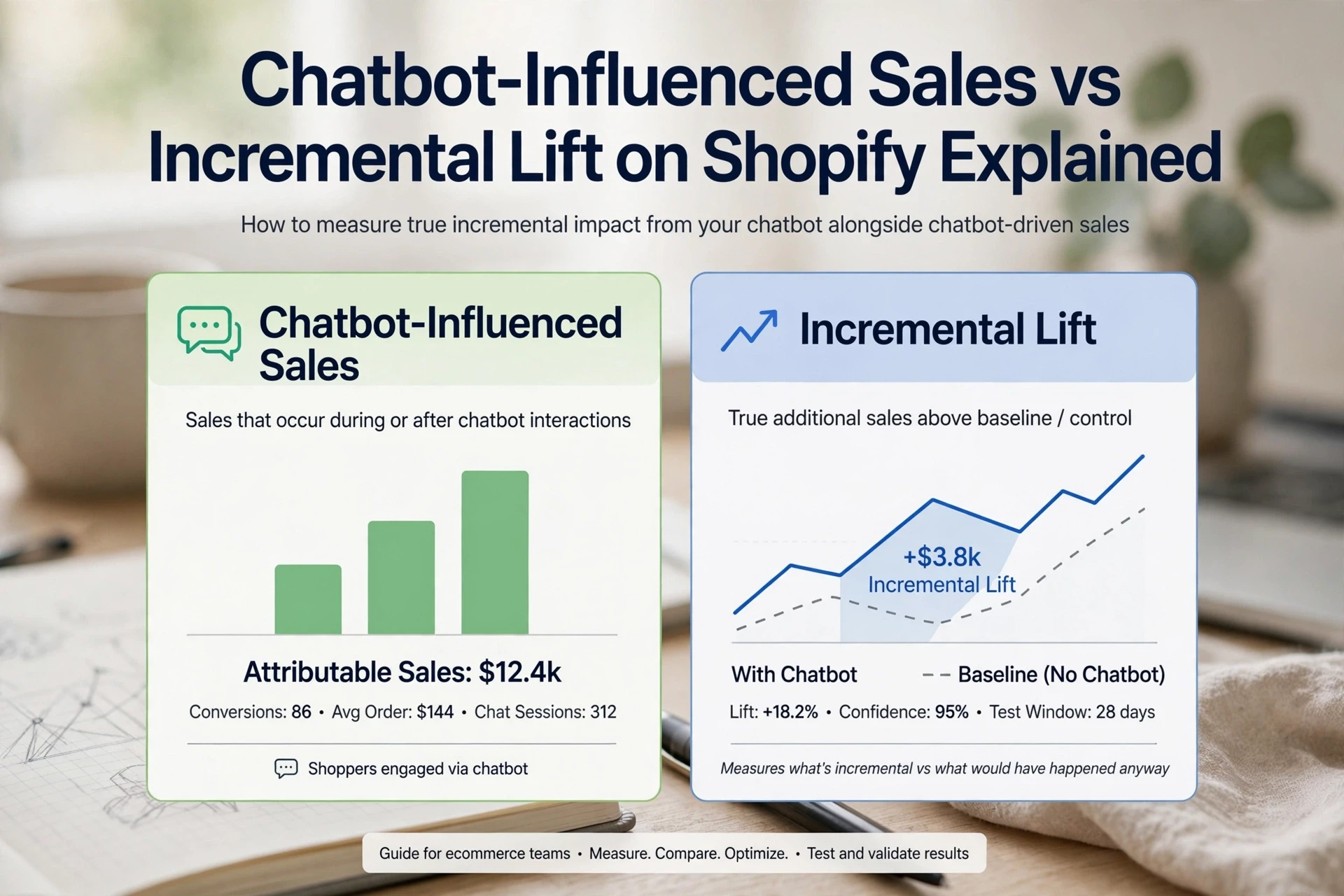
Influenced revenue counts orders where a shopper chatted before buying. It shows correlation, not cause. Many of those buyers would have purchased anyway - the chatbot simply showed up in their journey. Think of it as credit assigned, not sales created. It answers: "How often is the chatbot present near a purchase?"
What Incremental Lift Measures
Chatbot incremental conversion lift measures what the chatbot actually caused. You split traffic: one group gets the chatbot, a control group does not. The difference in conversion rates is your lift. If both groups buy at the same rate, the chatbot added nothing, no matter what its dashboard says.
Track influenced revenue weekly, but test lift quarterly. Use one for operations, the other for budget.
| Metric | Question it answers | Proof level |
|---|---|---|
| Influenced sales | Was the chatbot part of the journey? | Correlation |
| Incremental lift | Did the chatbot cause extra orders? | Causal, tested |
As Search Engine Land explains, attributed conversions don't always equal incremental growth, and incrementality testing is the only way to separate sales the chatbot caused from sales that happened regardless.
Also Read: 7 Shopify Chatbot Apps That Help Stores Convert More Visitors
Build a Shopify Chatbot Measurement Layer
Before you claim any chatbot incremental conversion lift, you need clean data. Use Shopify's customer events and pixels to capture every chat interaction alongside standard store events.
Track the Full Interaction Path
Log the whole journey, not just the last click:
- Chat opened - timestamp and entry page.
- Product recommended - which item the bot suggested.
- Add to cart and checkout started.
- Purchase completed, tied to the session.
Shopify's Web Pixels API lets you subscribe to standard events like product_viewed and checkout_completed, so chat events and store events share one timeline.
Join Events to Shopify Orders Conservatively
Match chat sessions to orders using a stable key like email or checkout token. Even then, treat matched orders as influenced, not caused. Many buyers would have purchased anyway, which is exactly why attribution tools need careful setup before you trust the numbers.
Also Read: AI Sales Agents: 7 Metrics to Prove Revenue Impact
Run a Test for True Chatbot Incrementality
Attribution tells you which orders a chat touched. Only a controlled test tells you what it caused. The standard method is a holdout: hide the chatbot from a small, random slice of visitors and compare revenue per visitor between groups over the same weeks, so both sides see the same promos and seasonality. This is how online controlled experiments isolate causal lift in ecommerce.
Assign Treatment and Control Randomly
- Pick the unit: visitor level, not session level, so returning shoppers stay in one group.
- Split randomly - 90/10 treatment-to-holdout works for most stores.
- Never split by device, country, or traffic source. That imports bias.
- Set the sample size and end date before launch, then don't stop early.

Measure the Outcome and Check Test Quality
Compare revenue per visitor between groups, not chat-attributed orders. Run the test 2 to 4 weeks to cover weekday swings. Before calling a winner, check that groups were similar before launch, that lift clears statistical confidence, and that you analyzed every assigned visitor - even ones who never opened the chat. Skipping that last check is the most common way holdout tests produce inflated numbers.
Also Read: How to Measure Ecommerce Chatbot Revenue Attribution
Choose the Right Metric for the Decision
Match the metric to the question you're asking.
| Question | Right Metric | Wrong Metric |
|---|---|---|
| Which channel gets daily budget tweaks? | Last-click and assisted attribution | Lift testing (too slow) |
| Should we pay for this chatbot? | Incremental lift from a holdout test | Chatbot-attributed revenue alone |
| How many orders did chat touch? | Chat-influenced orders (label them clearly) | Total store revenue |
Influenced orders show reach. Lift shows caused sales. As Polar Analytics explains, a reported 4.0x ROAS can be 1.6x real. Attribution can't see the counterfactual, which is why last-click misleads budget decisions.
Use both. Report influenced orders honestly, then test for lift.
Chatbot-influenced orders aren't proof of lift. See how Kandid helps you run fair Shopify lift tests.
Frequently Asked Questions
Q1: How do I separate chatbot-influenced sales from incremental conversion lift on Shopify?
Tag orders that involved chat sessions, then run a controlled test: hold the chatbot off for a random slice of traffic. The gap between groups is your lift; the rest is influence.
Q2: Is a high chatbot-assisted conversion rate proof the chatbot works?
No. Shoppers who chat were often ready to buy anyway. Compare matched periods and traffic sources before crediting the bot.
Q3: Can Shopify's built-in reports show chatbot lift?
Not directly. You'll need session tagging plus a holdout test or geo split to isolate incremental revenue.
Q4: How long should a lift test run?
At least two to four full weeks, covering both weekday and weekend patterns, before trusting the numbers.
Conclusion
Chatbot-influenced orders show correlation, not proof. Track chat-assisted revenue separately, use strict attribution, then run holdout tests to measure real incremental lift, as holdout testing shows.