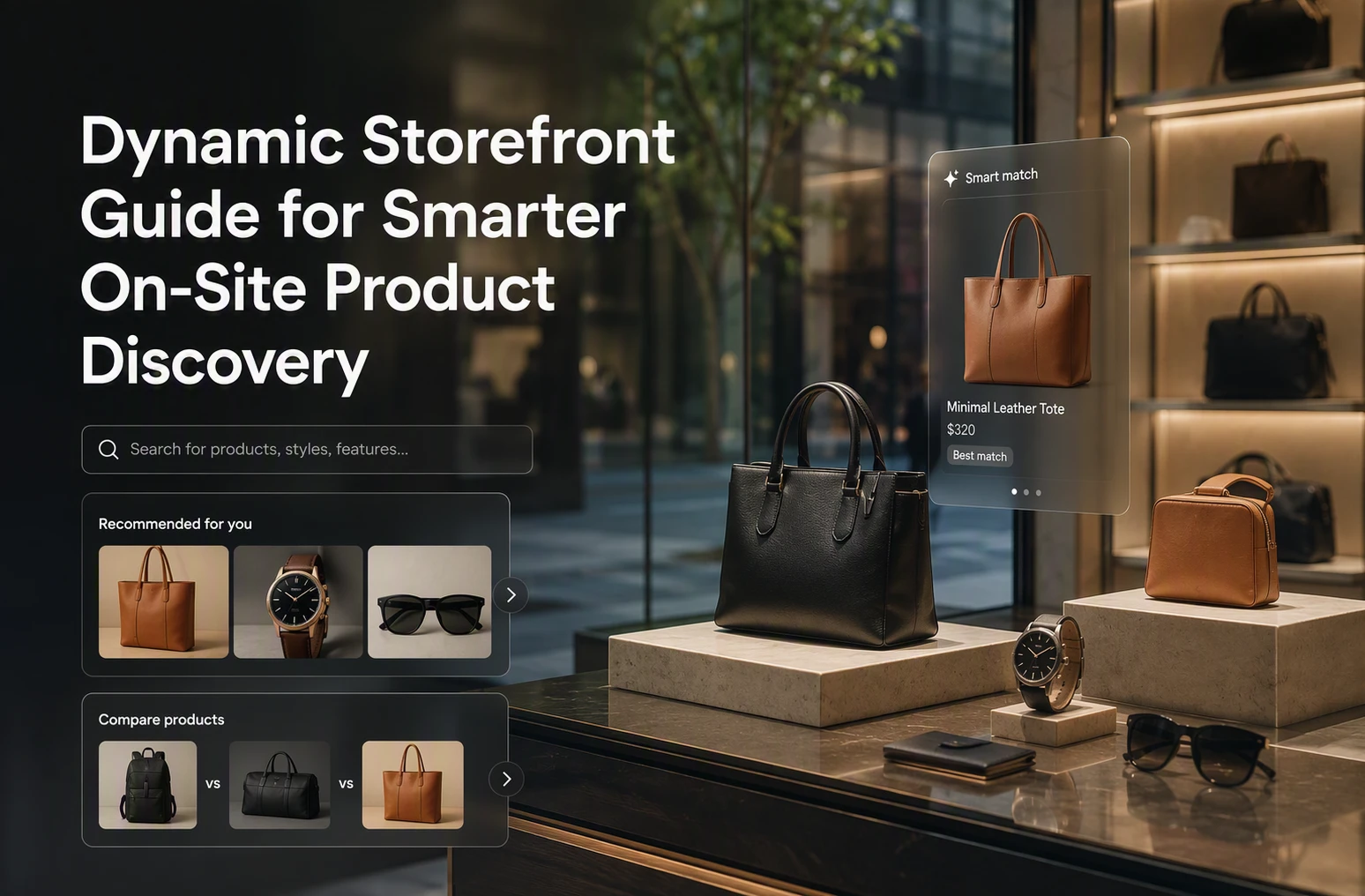
Dynamic Storefront Guide for Smarter On-Site Product Discovery
Quick Summary: Dynamic storefronts improve on-site product discovery by making search, category pages, and recommendations react to shopper signals, stock, and intent. Using real-time data like clicks and dwell time helps re-rank products, while grouping queries by intent enhances landing pages. Keeping merchandiser control within AI-driven systems boosts conversions without sacrificing brand rules.
If your Shopify Plus or headless store shows the same category order, promo tiles, and Ecommerce Product Recommendations to everyone, On-Site Product Discovery turns into guesswork. This guide shows how to fix that with dynamic storefront logic that reacts to intent, stock, and Real-Time Customer Engagement while keeping merchandiser control. I’ll focus on the practical parts of On-Site Product Discovery, where teams usually get stuck, and what actually improves On-Site Product Discovery without losing brand rules.
1. Map the discovery surfaces that need to become dynamic
Start with pages where buyers already show intent: site search, autocomplete, category grids, filtered listing pages, and query-led landing pages. Baymard found roughly half of shoppers use search as a main product-finding method, and 56% of sites still fail Search UX basics in 2026, so these surfaces deserve first attention (Baymard search findings).
- Prioritize:
- Search results
- Category pages
- Filter states
- Recommendation modules
Separate editorial content from decision surfaces. Blog pages can stay mostly static. Decision surfaces should react to query, stock, margin, and shopper context. Baymard also notes 46% of sites fail to guide searchers into matching category scopes, which hurts filtering and relevance (category scope guidance).
| Surface | Should be dynamic? | Why |
|---|---|---|
| Blog article | Low | Inform, not rank products |
| Search results | High | Strong purchase intent |
| Category page | High | Users compare options |
| PDP recommendations | High | Push next best product |
Also Read: 7 Dynamic Storefront Features That Improve Product Discovery
2. Use shopper signals to re-rank products in real time
Prioritize signals that change intent quickly. Clicks, filter use, dwell time, add-to-cart, and repeated spec checks tell you more than old cohort tags. In TREC 2025 product search, NIST notes that task-based queries often hide intent, and teams improved results with query reformulation and reranking rather than static lexical matching alone in the TREC 2025 proceedings. Weight fresh signals highest, then decay them fast.

Set fallback rules for new or low-signal visitors. You need a safe default when the session is thin. Start with:
- Query match
- Category popularity
- Margin or inventory guardrails
- Region, device, and price band
Use a simple rules table so teams align fast:
| Visitor state | Primary rank input | Fallback |
|---|---|---|
| New visitor | Query and category | Best sellers |
| Low-signal session | Recent clicks | Popular in stock |
| Returning visitor | Past behavior + live actions | Brand rules |
If signals conflict, trust the latest high-intent action first.
Preserve merchandising control inside the AI layer. Let AI reorder within bounds, not everywhere. Pin hero SKUs, block low-stock items, and set brand rules by query. TREC runs show fused and reranked systems can beat plain BM25 baselines while keeping retrieval efficient in the official runs list. Kandid fits well here because merch teams keep control while the model adapts live.
Also Read: How to Build a Dynamic Storefront for Maximum Conversion
3. Shape landing experiences around query intent
Group queries by intent, not exact wording. One landing page can serve "vegan SPF moisturizer," "clean sunscreen for dry skin," and close variants if the page matches the same need. That matters because modern search works better when it reads shopper intent, not just keywords, as Salesforce notes.

Keep the main query signal obvious on the page:
- Repeat the need in the headline.
- Show matching filters and top products first.
- Add short helper copy for fit, specs, or use case.
If shoppers search by feature or use case, do not drop them on a generic collection.
Also Read: 10 Effective Strategies to Optimize Your Dynamic Storefront
4. Measure discovery lift and refine the system
Track lift by surface, not just by session. Split results across search, collection pages, recommendations, and query-aware landing pages. Baymard found 1,000+ product-finding usability issues in recent research, so broad session metrics can hide weak spots in the journey (Baymard product-finding research).
Watch for over-personalization and stale rules. If repeat visitors see narrow results too fast, discovery shrinks. Review zero-result rates, filter use, assisted revenue, and merch overrides weekly. Baymard also notes search UX still shows major gaps across 344 leading sites, which is a good reminder to keep testing and tuning (Baymard search research).

Want smarter product discovery without losing control? Kandid adds real-time AI sales agents that guide shoppers, answer fit questions, and lift conversion fast.
Frequently Asked Questions
Q1: What key strategies improve eCommerce product discovery for increasing conversions?
Use query-aware ranking, strong filters, clear category paths, smart search, and real-time product recommendations. Keep merchandiser rules in place so high-margin, in-stock, and seasonal products stay visible when shopper intent shifts.
Q2: How does AI-driven personalization enhance on-site product discovery?
AI reads live behavior, search terms, cart signals, and product affinity to reorder results for each shopper. That cuts friction fast. Tools like Kandid also help answer fit, spec, and compatibility questions during the session.
Q3: What are best practices for optimizing mobile product discovery in online stores?
Keep search sticky, filters simple, and sort options short. Show key specs above the fold. Use thumb-friendly controls, fast page loads, and tighter result sets so shoppers can compare products without pinching, zooming, or bouncing.
Conclusion
Dynamic storefronts help shoppers find the right products faster while keeping merchandisers in control. That matters because searchers can drive 44% of site revenue, according to Constructor's 2025 study. The win is simple: better ranking, better discovery, better conversion.