AI Sales Agent vs Sales Assistant: What Should D2C Brands Choose?
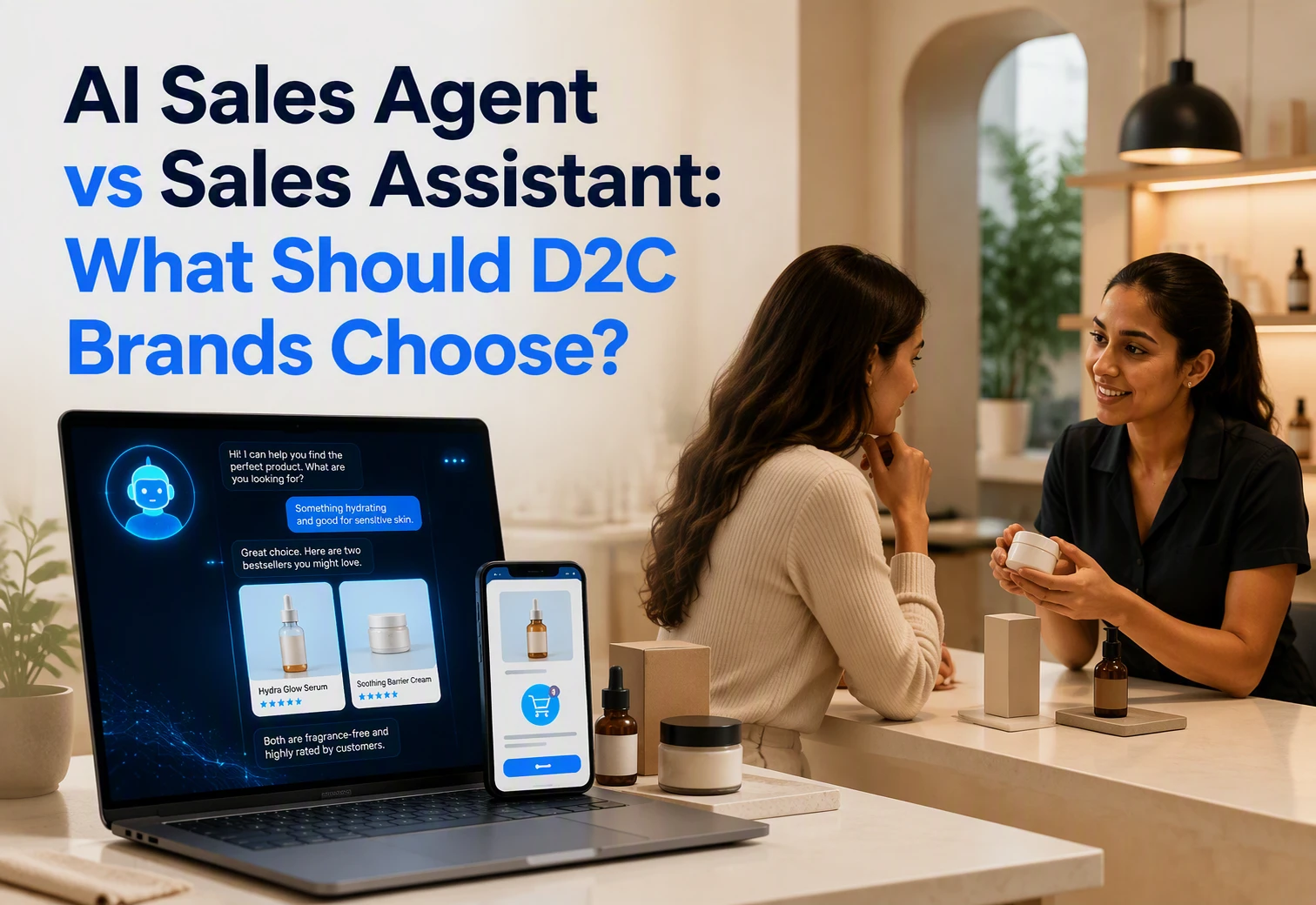
Quick Summary: Choose an AI sales agent when shoppers need help comparing products, checking fit, or solving compatibility issues before buying. Choose a sales assistant for order status, returns, and simple FAQs. Track conversion rate, average order value, and ticket deflection to measure success.
At 11:47 p.m., a shopper needs a size and compatibility answer. An AI sales agent can compare SKUs and drive a cart add. A sales assistant may route them to support. In the AI sales agent vs sales assistant choice, sales tools fix lost orders; assistants cut tickets. This comparison tests both by job, data, actions, and metrics.
AI Sales Agent vs Sales Assistant: At a Glance
| AI sales agent | Sales assistant | |
|---|---|---|
| Primary job | Drive product decisions and purchases | Answer questions and assist customers |
| Best shopper moment | Pre-purchase hesitation or comparison | FAQ, navigation, or service request |
| Core data required | Catalog, variants, pricing, inventory, and merchandising rules | FAQs, policies, help content, and sometimes order context |
| Typical action | Recommend, compare, upsell, and add to cart | Explain, link, collect details, and escalate |
| Success metric | Conversion rate, AOV, and assisted revenue | Resolution rate, response time, and ticket reduction |
| Best fit | D2C brands with complex or consultative products | Stores with high repetitive support volume |
How AI sales agent and Sales assistant Compare
AI sales agent
An AI sales agent helps shoppers choose products and move toward checkout. It fits D2C stores where sizing, fit, specs, variants, or product comparisons slow decisions. Its job centers on revenue actions, using catalog and inventory data to recommend, compare, upsell, and add items to cart. Key strengths
- Supports high-intent pre-purchase shoppers
- Tracks conversion rate, AOV, and assisted revenue
Sales assistant
A sales assistant answers questions and guides shoppers through basic store tasks. It suits stores with many repeat FAQs, policy questions, and service requests. Its role centers on quick help, links, detail collection, and handoff when a customer needs more support. Key strengths
- Reduces routine support tickets
- Tracks response time and resolution rate
The Real Difference Is the Job After the Answer
Product uncertainty versus service friction
A sales assistant solves product uncertainty before checkout: Which size fits? Will this part work? Which bundle meets my goal? It should compare choices and recommend a next step. Shopify describes virtual shopping assistants as tools that guide discovery and purchase decisions with tailored advice here.

A sales agent earns its keep when shoppers need help choosing, not just facts.
Reactive help versus guided purchase action
Support automation handles service friction after a problem appears:
- Where is my order?
- How do I return it?
- What is your shipping policy?
A sales agent asks a useful follow-up, narrows the catalog, and brings the shopper to the right product. Track its impact through add-to-cart rate, conversion rate, and AOV.
Do not judge both tools by ticket deflection. That measures support savings, not purchase guidance.
Also Read: AI Sales Agent vs Rule-Based Bot: Which Drives Better Sales?
Which Option Fits Your D2C Bottleneck?
Choose an AI sales agent when choice is blocking checkout
Pick an AI sales agent if shoppers ask, "Which size fits?" or "Will this work with mine?" before leaving. It should compare products, explain tradeoffs, and guide the next step toward checkout.

| Signal | Best fit |
|---|---|
| High product-page exits | AI sales agent |
| Repeated fit or compatibility questions | AI sales agent |
Test answers against your catalog. NIST advises organizations to manage AI risks based on their goals and context in its AI risk framework.
Choose a sales assistant when support workload is the constraint
Choose a sales assistant if the team is buried in order status, returns, and basic policy questions. It should deflect repeat tickets and route exceptions to people.
Also Read: 7 AI Sales Agents With Human Handoff for Complex Purchases
How to Evaluate the Choice Without Chasing Vanity Metrics
Measure the outcome each tool is hired to improve
An AI sales agent should lift product-page conversion, AOV, and qualified carts. A sales assistant should cut ticket volume and first-response time.
| Tool role | Primary metric | Guardrail |
|---|---|---|
| Sales agent | Conversion rate | Returns and refunds |
| Sales assistant | Tickets resolved | Customer satisfaction |
Shopify defines conversion as sessions that result in an order in its behavior reports.
Do not treat chat volume as success. It can signal shopper confusion.
Run a narrow Shopify pilot first
- Pick one high-consideration collection.
- Record a four-week baseline.
- Send half of eligible traffic to the pilot.
- Compare conversion, AOV, tickets, and returns.
- Keep traffic sources, offers, and page layout steady.
- Review net sales, not only gross orders.
Shopify reports include sales reversals in net sales, making it a stronger revenue check than headline order count.
Also Read: 7 AI Sales Agents for D2C Product Qualification
Which Should You Choose: AI Sales Agent or Sales Assistant?
Choose an AI sales agent if shoppers must compare products, check fit, or solve compatibility questions before buying. Choose a sales assistant if most chats involve order status, returns, and simple FAQs.
| Store need | Best choice |
|---|---|
| Product guidance that drives checkout | AI sales agent |
| Post-purchase ticket deflection | Sales assistant |
Shopify notes that AI retail chatbots can recommend products and complete checkout. Read Shopify's overview
Turn product questions into purchases. Kandid guides shoppers through fit, specs, and comparisons in real time.
Frequently Asked Questions
Q1: Should D2C brands choose an AI sales agent or sales assistant?
Choose an AI sales agent if shoppers need help picking products. Choose a sales assistant for order status, returns, and basic support.
Q2: What should we measure first?
Track conversion rate, assisted revenue, average order value, and support ticket volume.
Q3: Can one tool handle both?
Yes, but test product guidance separately from support flows.
Conclusion
Choose an AI sales agent for product decisions and revenue. Choose an assistant for service tasks. Track conversion, average order value, and ticket deflection, as Shopify explains.